
Martin Correctional Institution Release Paths
Martin Correctional Institution is the main unit of an FDC state-prison complex in Indiantown. Its Martin C.I. Work Camp is a state component, not a separate county facility. When FDC relinquishes physical custody, a person may discharge to the community without more supervision or may begin parole, conditional release, probation-type supervision, or another state-managed status. The FDC offender record is the central public source because it can preserve release dates and prison history after the person leaves the institution.
Movement is not always release. A transfer to another FDC institution keeps the person in state custody. Placement in a community release center can change the location and degree of custody without completing the sentence. Read the current location, status, sentence history, Release Date, and Date Out-Custody together before stating that the person returned to the community.
Search Martin Correctional Institution Releases
FDC separates current prison population, inmate releases, supervised population, and absconder records. Select the database that matches the question, then open the full detail instead of relying on one results row.
- Open the FDC Corrections Offender Network menu.
- Use the six-character DC number when known. Otherwise, search by first and last name, aliases, and the available photo or result controls.
- Choose Inmate Population for a person thought to remain in state prison. Read Current Facility, Current Custody, and Current Release Date.
- Choose Inmate Releases for a person believed to have left FDC custody. Read Release Date and the Date In-Custody or Date Out-Custody history.
- If supervision follows, open the Supervised Population record and compare its type, status, office, start date, and scheduled termination.
- Request the underlying FDC record when a public profile conflicts with a sentence or does not clearly show the movement.
The FDC search form is shown on the official offender-search screen.
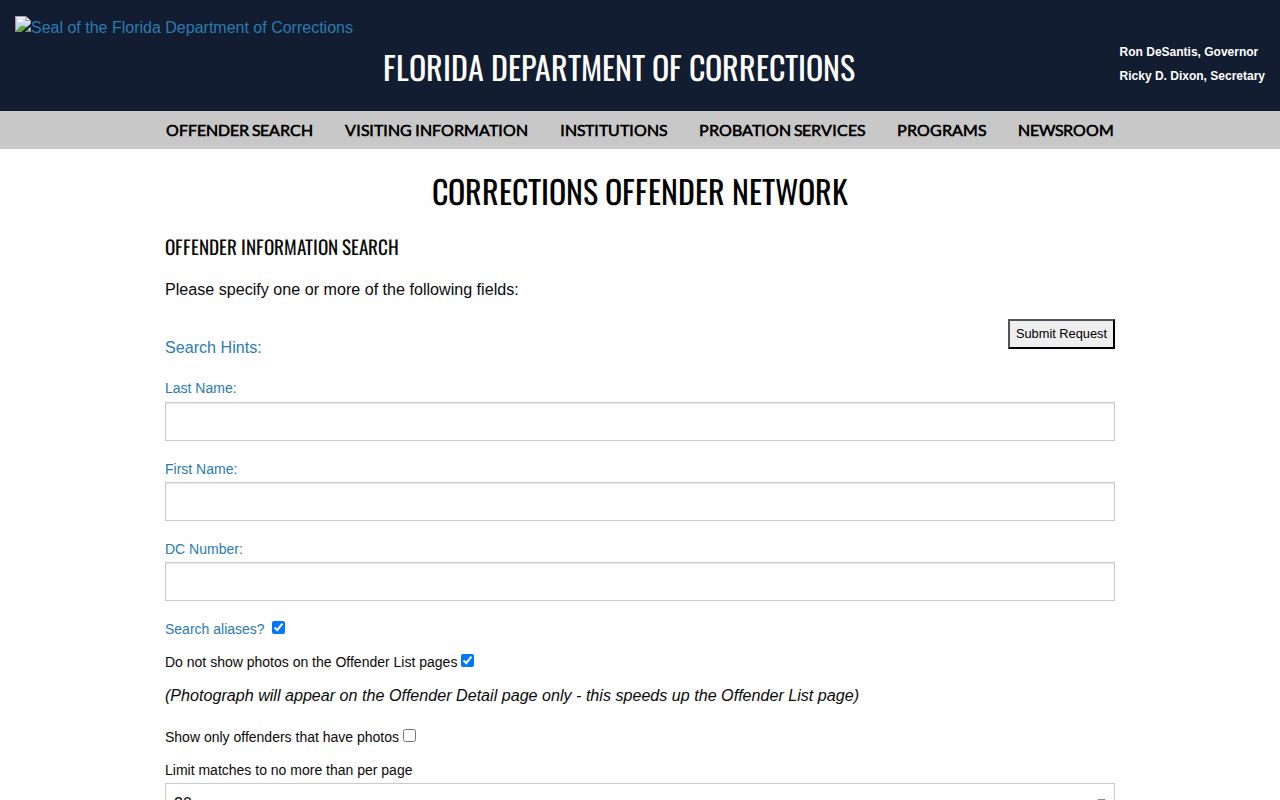
This statewide search covers FDC prison and state-supervision records, not a person whose only custody was at Martin County Jail.
Martin Institution Release Record Fields
FDC’s public fields answer different questions. A custody classification such as medium does not by itself mean the person remains physically confined. The incarceration history and release fields supply the needed time context.
| FDC field | What it can establish | Limit |
|---|---|---|
| DC number | The six-character state identifier for the person | It is not a Martin County booking number |
| Current Facility | The institution named in a current population profile | Location may change before a full refresh |
| Current Release Date | FDC’s public projected-date field for a current prisoner | It is not an actual release timestamp |
| Release Date | The date displayed in an Inmate Releases detail | Read it with the custody history |
| Date In-Custody / Date Out-Custody | The bounds of a documented incarceration period | Another period or authority may also appear |
| Supervision Type and Status | The state status that follows physical release | FDC warns that county probation is excluded |
The Inmate Releases detail does not always print a broad “Released” or “Discharged” label. Use the exact Release Date and custody-history wording rather than adding a status the record does not show.
Read Martin Institution Release History
A public released-offender example shows how FDC preserves state correctional history. The detail can include a photograph, DC number, identity, Release Date, sentence information, and Date Out-Custody even after physical prison custody ends.
The FDC released-offender example illustrates the field layout without turning a current-only roster into a historical search.
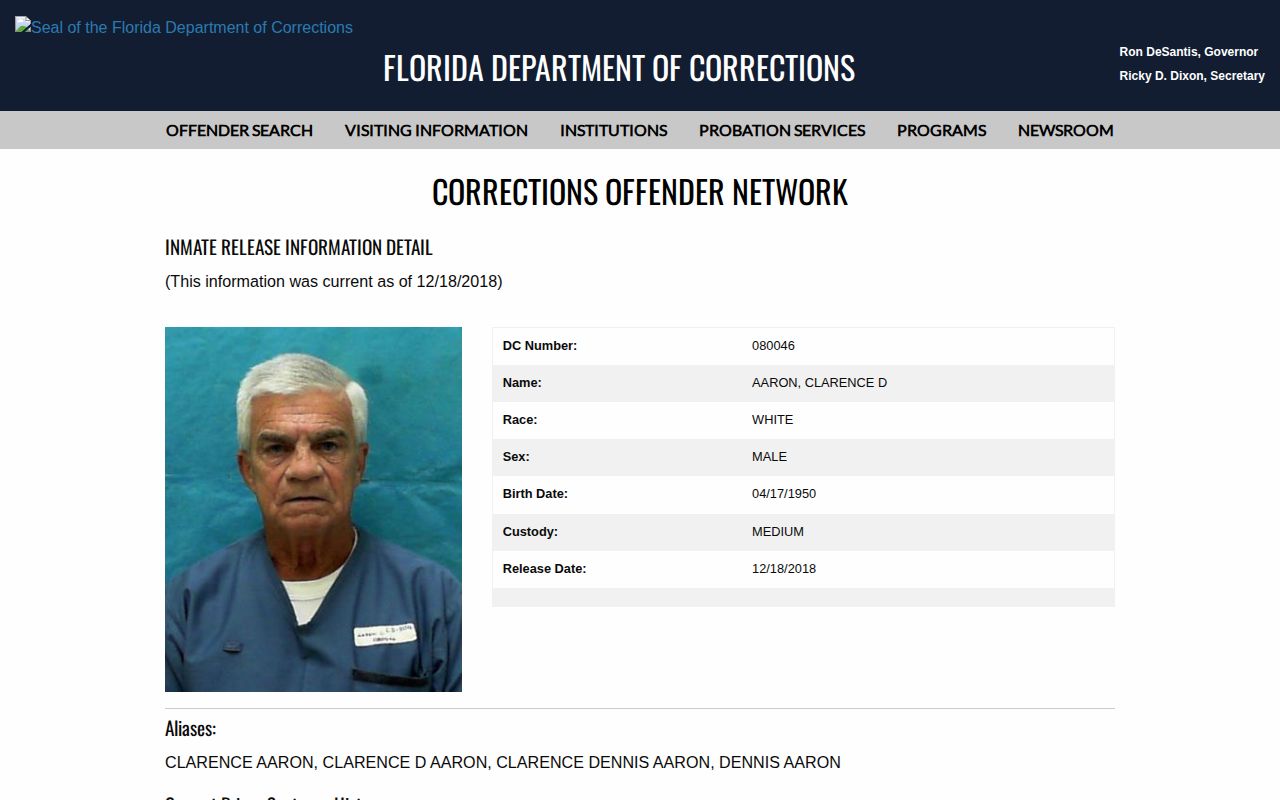
The example explains where the relevant dates appear. A search for a specific person still requires identity matching and review of that person’s own sentence and custody periods.
Martin Institution Release Data Timing
FDC publishes useful update information. The inmate-population database receives a full weekly refresh, while release dates and locations update nightly. The Inmate Releases database, which includes released people and some people scheduled for release, updates nightly. Supervised and absconder databases receive weekly full refreshes, with termination dates and locations updated nightly.
Nightly does not mean instant. A court change, physical move, or release may not appear at the same moment it occurs. FDC also warns that fast-changing data may not reflect the true current location, status, or release date. Confirm a time-sensitive conflict through FDC Admission and Release or Central Records.
Note: A change from Martin Correctional Institution to another FDC location is a movement record unless the release history establishes discharge.
Martin Institution Projected Release Dates
A current FDC profile labels the projected field Current Release Date. Florida § 944.275(3) calls the underlying calculation a tentative release date. The two phrases describe the public display and statutory concept, not two separate guarantees.
The date can reflect sentence structure, court-awarded credit, gain time, forfeiture or restoration, a changed court order, consecutive terms, detainers, and the release mechanism. For applicable sentences, Florida’s incentive gain-time rule prevents release below 85 percent of the sentence imposed. Offense date, sentence date, exclusions, and eligibility still matter, so a simple percentage is not a complete calculator.
Request Martin Institution Release Records
FDC, not MCSO, is custodian of the Martin Correctional Institution admission, movement, photograph, and release records. Ask by full name and DC number, identify the date range, and name the fields or documents needed. A precise request can seek the admission and release record, movement or out-of-custody history, and an available state offender photograph.
- Open the FDC public-records route and identify Martin Correctional Institution as the relevant institution.
- Supply the full name, DC number, and a narrow date range.
- Ask for the specific release, discharge, movement, or out-of-custody record rather than requesting research.
- Request an estimate before paid work and ask for nonexempt portions when redaction applies.
- Obtain the judgment or amended sentencing order separately from the proper court clerk.
Custodian: James Best
501 S. Calhoun Street
Tallahassee, FL 32399
Assistance: 850-717-9774
Fax: 850-488-4534
The FDC Public Records page explains estimates, review, redaction, and the rule that the department need not create a new record or perform research.
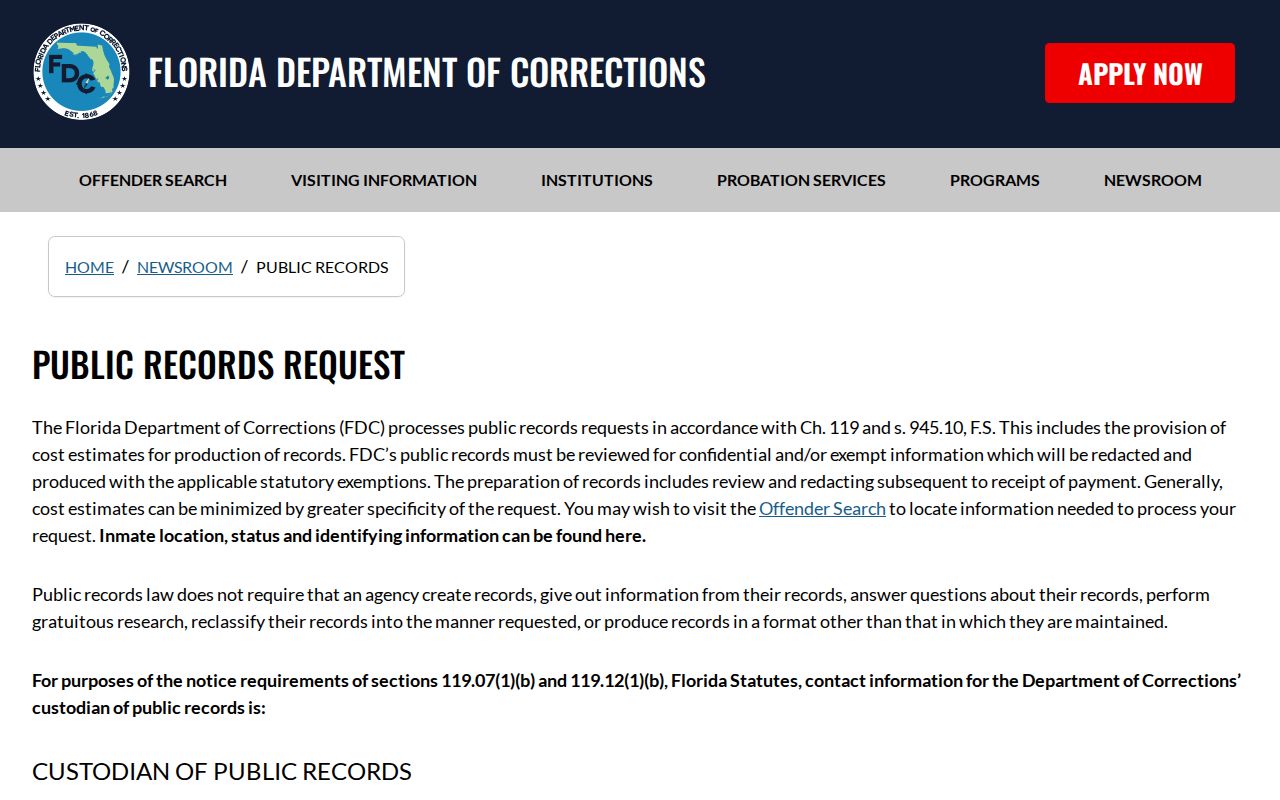
Florida Chapter 119 governs access, while § 945.10 protects specified medical, investigative, safety-sensitive, and victim information. An unredacted file should not be promised.
Martin Correctional Institution Contact
The official audit identifies the main institution’s location and phone. Facility staff can address institution-specific routing, but public offender and release details should be checked through FDC search and records channels.
1150 SW Allapattah Road
Indiantown, FL 34956
772-597-8100
Classification and Central Records can be reached at 850-488-9859 or central.classification@fdc.myflorida.com. FDC Admission and Release lists 850-488-9167 and dc.release@fdc.myflorida.com. Use those statewide routes when the public status or release date needs clarification.
Martin Institution Release Supervision
Physical release and discharge from the correctional system are not always the same event. A person may leave Martin Correctional Institution and begin state community supervision. The FDC Supervised Population record can show the supervision begin date, current location or office, current status, supervision type, and scheduled termination date.
Parole and some other release-authority decisions belong to the Florida Commission on Offender Review. When FCOR has jurisdiction, compare its Commission Action with the FDC Release Date and supervision record. A scheduled hearing is not a release order, and a favorable action may set a later effective date or conditions.
- Transfer
- Movement to another custodian or FDC site without final discharge.
- Community release setting
- A less restrictive FDC placement that may still involve correctional custody.
- Release
- End of physical custody by the identified institution or agency.
- Discharge
- Completion of the controlling custody or supervision term.
Martin Institution ICE Custody Handoffs
Immigration custody is a separate authority. Research for Martin County documents MCSO’s rule that its county jail does not disclose immigration-hold information and directs those jail questions to ICE. That county-jail policy does not mean MCSO holds or manages people at Martin Correctional Institution, which is an FDC state prison.
If an earlier Martin County booking ended with an ICE pickup, use the county disposition and ICE or ERO records for that handoff. If the person later entered FDC and was released from Martin Correctional Institution, start with the FDC release history and follow any receiving authority named in the record. A transfer to ICE, federal custody, or another agency is not community release.
Confirm Martin Institution Discharge
For the strongest confirmation, capture the person’s FDC Release Date and Date Out-Custody, compare both with sentence history, and check whether state supervision begins next. Use the full Martin County release-search path only to separate an earlier county booking from the later FDC term.
A court judgment can explain the sentence, but it may not reflect the final administrative date after gain time, forfeiture, correction, or a later order. When legal precision matters, request the FDC source record and obtain the sentencing or amended order from the clerk. The evidence should show who relinquished custody, when that occurred, and whether another authority or supervision status followed.