
Martin County Release Date Types
A projected release date is a calculation made before custody ends. For a person serving a Florida Department of Corrections sentence, the public profile calls it the Current Release Date. Florida law calls the underlying calculation a tentative release date. Both terms describe a date that can still change. An actual release date, by contrast, records when an agency relinquished custody. Martin County Jail booking detail may show an actual Release date/time after the event, while an FDC release profile can preserve Release Date and Date Out-Custody.
Pretrial custody works differently. Someone held at Martin County Jail before disposition generally has no sentence-expiration date. Departure may depend on bond, a dismissal, another court order, case resolution, or an outside hold. Even a court order does not establish the exact time that release processing ended. A court closed date is also a different event. It can fall before or after physical release.
Transfer must be kept separate as well. Martin County may close its booking because FDC, another county, or a federal or immigration authority takes custody. That is not a community release. Read the disposition and the next agency's record before drawing a conclusion.
Find a Martin County Release Date
The correct search route follows the custodian. Martin County Jail, Martin Correctional Institution, and the Martin Correctional Institution Work Camp are not covered by one release calculator. MCSO controls its county booking and release record. FDC controls a state prison sentence computation. The Martin County Clerk holds the judgment and later sentence orders that may explain the calculation.
- Identify the custody system. Use MCSO for a county jail stay and FDC for a state prison term. A Martin County court case alone does not show which agency now holds the person.
- Check the sentence record. Search the Martin County court portal by name, case, date range, or court type. Review the judgment, sentence, jail credit, and amended orders.
- Open the correct FDC profile. Search by the six-character DC number when known. For a current prisoner, open the detail and read Current Release Date with the sentence and custody fields.
- Ask MCSO for a county computation. The public pages do not publish a local calculator. Contact Corrections or make a narrow records request for the current computed date and the policy applied.
- Confirm changes at the source. When the court file and public correctional profile conflict, request the operative record from the agency that performs the calculation.
The MCSO Jail Inmate Search bridge helps identify current county custody, but a person missing from the live view is not proven released. For a named past booking, use the retained release record. The broader Martin County released-inmate search explains how that historical confirmation differs from a projected-date check.
Here is the FDC offender search form used for state custody and sentence details.
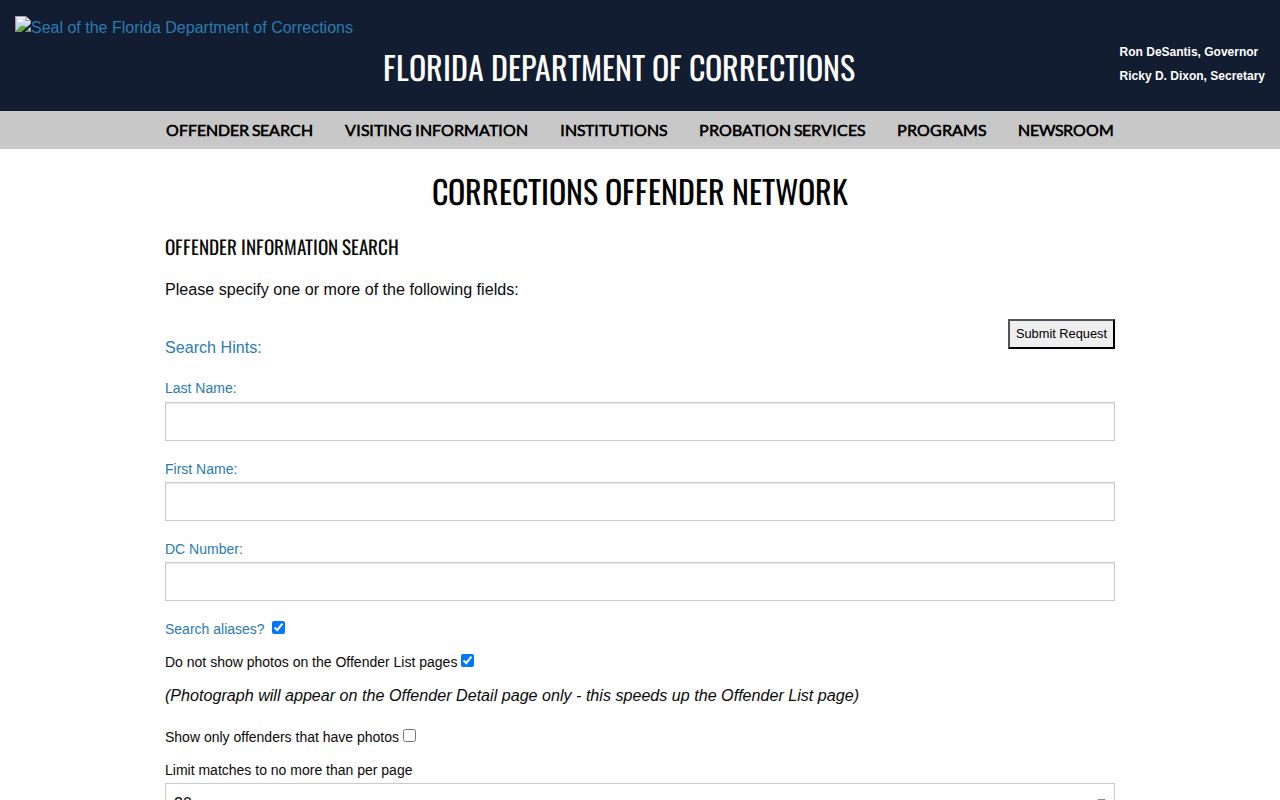
The result must be opened in full because the release field, sentence history, and location provide the context needed to read the date correctly.
Note: A Martin County booking number is not an FDC DC number, so match the identifier to the agency before searching.
Florida State Release Date Rules
Florida Statutes section 944.275 controls FDC gain time. Gain time is credit that can reduce the custodial part of an eligible sentence. It is not one flat award for every sentence. Basic ten-days-per-month credit belongs to an older offense-date regime. Incentive limits have also changed over time, including older twenty-day and twenty-five-day rules and a limit of up to ten days per month for offenses on or after October 1, 1995.
For the applicable post-1995 group, incentive gain time cannot cause release before service of 85 percent of the sentence, with court-awarded physical-incarceration credit counted. That rule is a floor, not a shortcut calculator. Mandatory minimums, serious-offense exclusions, a life sentence, consecutive cases, forfeited credit, or ineligibility can require more time. The offense date and governing law matter. FDC applies these rules to its population, not MCSO's county-only prisoners.
The official Florida gain-time statute shows why the percentage cannot be read in isolation.
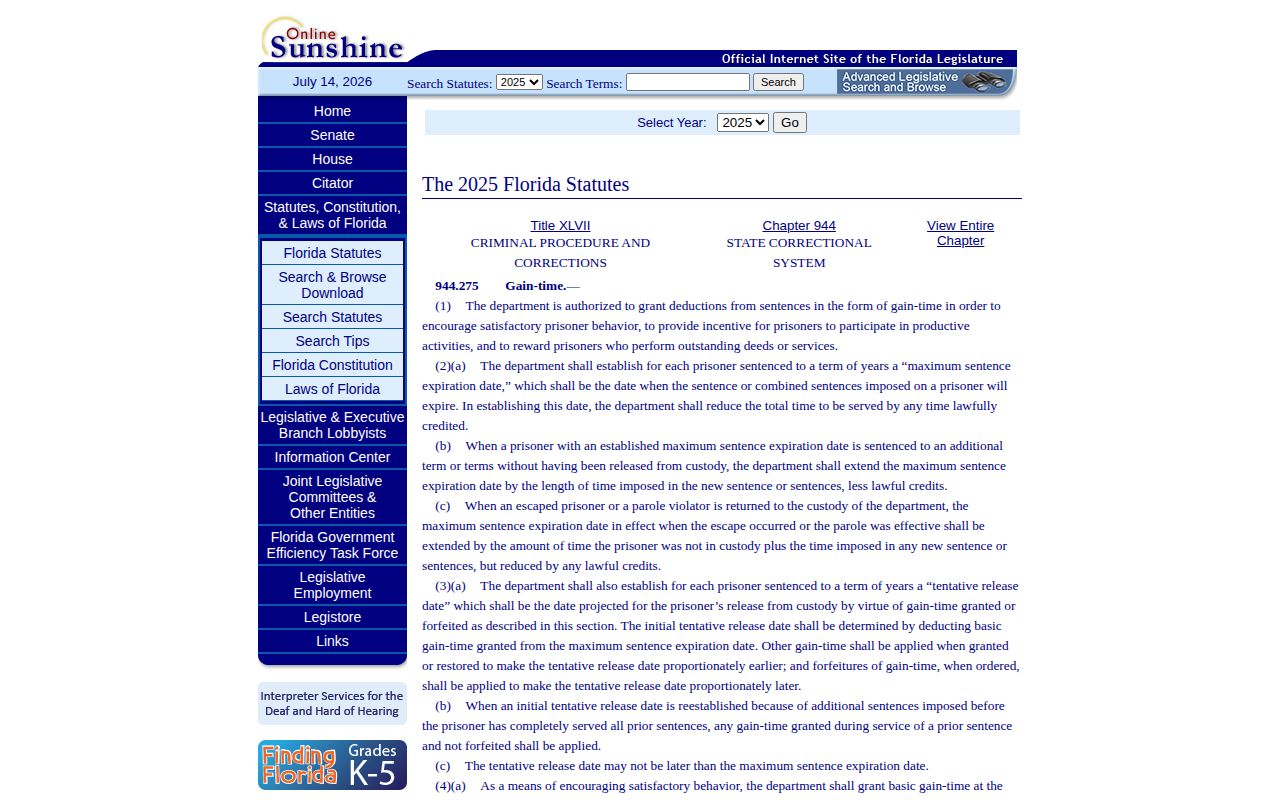
The statutory text also addresses granted, restored, and forfeited gain time, each of which can alter the tentative date maintained by FDC.
Martin County Good-Time Framework
County prisoners have a separate legal framework. Florida Statutes section 951.21 authorizes tiered good-conduct deductions when a county has adopted them and permits loss of credit for misconduct. The statutory ceilings rise by years served, but the existence of a maximum does not prove that each Martin County prisoner receives it.
MCSO's public pages do not state a simple local formula or confirm a special weekend rule. That gap is important. A county sentence should be checked against the judgment, certified jail credit, MCSO's current computation, and the policy actually in use. Do not apply the FDC 85-percent provision to a county jail term merely because both sentences arise in Florida.
Pre-sentence jail credit is another component. Section 921.161 requires credit for time spent in county jail before sentence and requires the local custodian to certify relevant custody periods for an FDC sentence. If the credited days are wrong or later corrected, the release-date computation changes.
Why Martin County Dates Change
A projected date is a live administrative result. The FDC population database receives a full weekly refresh, while release dates and location are updated nightly. The Inmate Releases database also updates nightly. That schedule does not guarantee that a new order or movement appears at once. MCSO does not publish an equivalent update schedule for its county booking portal.
| Change | Possible effect | Best record to check |
|---|---|---|
| Sentence correction or resentencing | Can move the computed date earlier or later | Operative court order and agency computation |
| Jail or prison credit correction | Adds or removes credited custody days | Judgment, custodian certification, and sentence history |
| Gain-time award or restoration | May move an eligible tentative date earlier | FDC or county computation record |
| Withholding or forfeiture | May move the date later after discipline | Correctional record and applicable rule |
| New or consecutive term | Changes the combined time structure | All judgments and sentence detail |
| Detainer or receiving agency | May cause a custody handoff on the date | Release disposition and receiving record |
| Parole or conditional-release action | May set, change, or condition a date | FCOR action and FDC profile |
A parole hearing is not a release order. The Florida Commission on Offender Review can set or modify a presumptive or effective release date within its jurisdiction, and a favorable action can still carry conditions. For state supervision, the FDC supervised-population record may show a scheduled termination date, but that is when supervision is due to end, not when prison custody ended.
Note: Nightly date updates improve access, but only the agency record and controlling court order resolve a material conflict.
Two Martin County Release Calculations
Martin County has no single calculator that covers jail and prison sentences. An eligible state sentence at Martin Correctional Institution is governed by FDC and section 944.275. A county sentence at Martin County Jail falls under the distinct county framework in section 951.21 and any locally adopted implementation. The 85-percent state restriction cannot be carried across that boundary.
This distinction also changes where questions go. FDC Admission and Release or Classification/Central Records handles the state calculation. MCSO Corrections handles the county computation, while the Martin County Clerk supplies the sentence and amended orders. A careful request identifies the person, case or DC number, sentence, and exact date field in dispute.
Confirm Martin County Release Timing
For a state prisoner, read Current Release Date with current location, custody data, sentence history, and any release-authority action. After the event, use the direct FDC Inmate Releases database and compare Release Date with Date Out-Custody. A release profile may not use a generic Released or Discharged label. Preserve the field names that actually appear.
The state databases serve different stages. The inmate-population detail is the better source while a person remains in an FDC institution because it carries Current Release Date. The FDC Inmate Releases search is release-first and preserves the historical Release Date and incarceration periods. If community supervision follows, the supervised-population search can add Supervision Begin Date, Current Location, Current Status, Supervision Type, and Scheduled Termination Date. None of those supervision fields should replace the prison release event. They describe the next legal phase.
For a county prisoner, call MCSO Corrections at 772-220-7200 or submit a focused request through the MCSO records portal. Ask for the current computed date if the person remains sentenced, or the actual release date/time and public disposition if custody has ended. The records response is stronger than an assumption based on disappearance from the live roster.
When FCOR action affects a date, obtain the actual Commission Action or order. A public hearing agenda shows scheduled business, not the final decision. Compare the order with FDC's date and status, then contact the assigned Community Corrections office if the record shows supervision. This final comparison separates three events that are often merged: authorization for release, physical departure from the institution, and the later end of supervision.
VINELink can alert a registrant to a participating custody event, but it is not the calculation authority. The Martin County VINE inmate check can help with prospective notice. Always confirm an alert with MCSO, FDC, or the named receiving agency, because transfer can mean custody continues elsewhere.
- Tentative release date
- The statutory term for FDC's projected calculation before custody ends.
- Current Release Date
- The label shown on an FDC current-prisoner public profile.
- Actual release date
- The historical date when a specific agency relinquished custody.
- Gain time
- Credit that may reduce an eligible sentence under the governing correctional framework.
- Detainer
- A notice that another authority may assume custody when the current hold ends.
A precise answer names both the date and its status. State whether it is projected, current, tentative, scheduled for supervision termination, or an actual release event. That small distinction prevents a forecast from being presented as completed release.
Note: A projected date, physical release, and final supervision discharge are three separate events that may appear in different records.