
Martin County Parole vs Probation
Probation is a court-ordered community sentence or part of a sentence. Parole is supervised release authorized under Florida’s parole framework, mainly for qualifying older-law cases. Conditional release and control release are separate statutory statuses. A record should be described by its exact label because “parole” is not a sound general term for everyone monitored after custody.
| Status | Who orders or administers it | Best verification source |
|---|---|---|
| State probation | Court order; FDC Community Corrections supervises | FDC Supervised Population profile, sentencing order, assigned unit |
| County probation | County court order; local provider administers | Martin County court docket and C.O.R.E. Probation |
| Parole | Florida Commission on Offender Review within its jurisdiction | FDC profile, FCOR agenda and Commission Action |
| Conditional release | FCOR release authority; field supervision through FDC | Exact FCOR action, FDC release and supervision records |
| Pretrial supervision | Court conditions before case resolution; MCSO program | Bond order, docket, and program record |
Florida abolished parole eligibility for most offenses committed on or after October 1, 1983, subject to statutory exceptions. Offense date and governing law matter. Do not infer parole from a release date, a reporting requirement, or an officer assignment.
Check Martin County Supervision
Verification starts with identity and the type of sentence. A Martin County Jail booking may contain little detail about later supervision, while an FDC profile can separate state supervision from prison history.
- Locate the exact Martin County court case. Read the judgment, sentence, probation order, violation entries, and termination documents.
- Search the FDC Corrections Offender Network by six-character DC number when known, or by name and identity details.
- Open the Supervised Population detail. Read Supervision Type, Supervision Begin Date, Current Status, Current Location, and Scheduled Termination Date together.
- If the record identifies the Stuart office, confirm uncertain or rapidly changing details with that unit. Follow the reporting method in the person’s conditions and officer instructions.
- For county probation, use the court docket and contact C.O.R.E. Probation. Its online report form is for an assigned probationer, not a public person search.
- If the status is parole or another FCOR-controlled release, inspect the hearing materials and obtain the final Commission Action.
The FDC Supervised Population search is the official statewide starting point for state supervision.
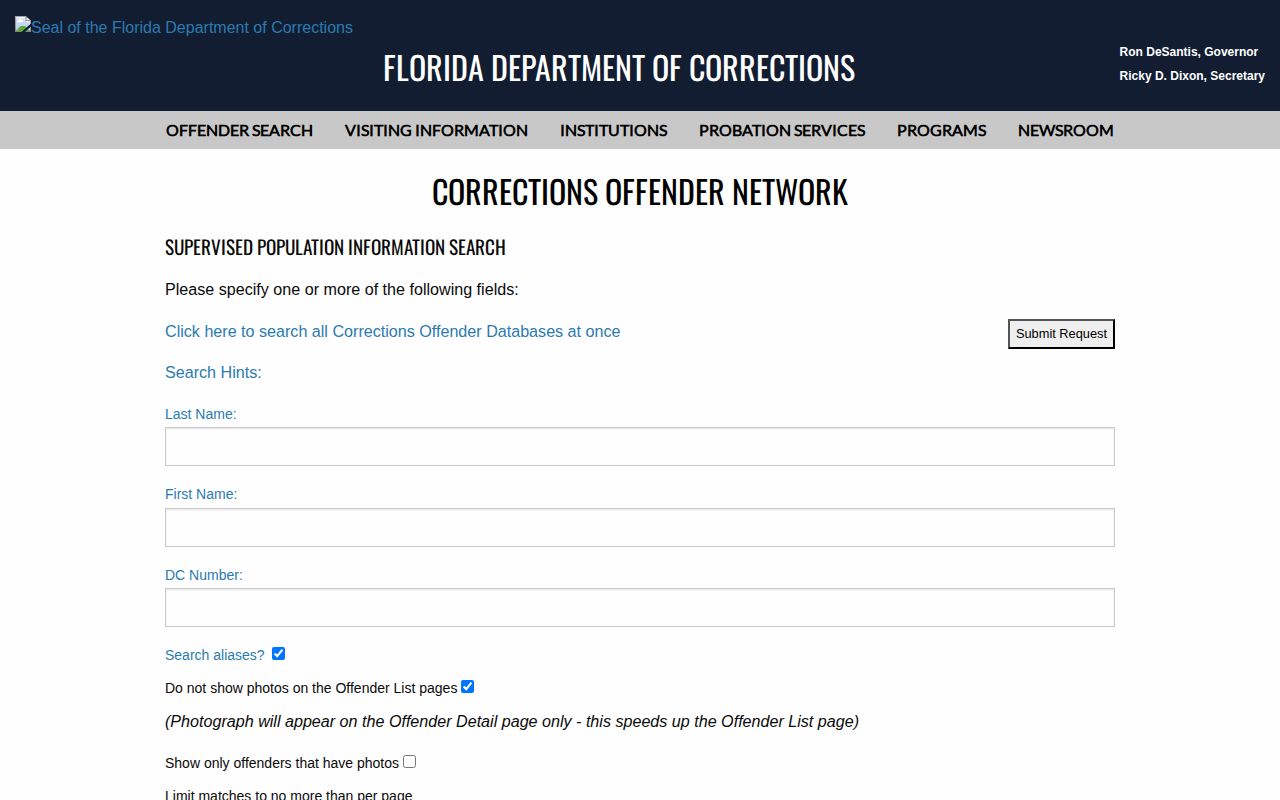
FDC warns that this database does not include county probation. An empty result may simply mean the Martin County case never entered the state supervision system.
Note: An empty FDC supervision result may mean the case belongs to county probation rather than the state system.
Martin County’s Two Supervision Routes
State and county supervision have visibly different local routes. FDC Community Corrections Circuit 19 operates Unit 191 in Stuart for state felony and community-corrections cases. County probation is routed by the Martin County Clerk to C.O.R.E. Probation. The systems should not be merged in a single search claim.
2015 S. Kanner Highway
Stuart, FL 34994-2237
772-221-4010
Fax: 772-221-4999
The FDC Circuit 19 directory also lists circuit headquarters in Fort Pierce at 2806 S. US Highway 1, phone 772-468-3933. The Current Location field should lead to the responsible office.
C.O.R.E. Probation can be reached at 772-286-7352. Official local sources disagree on whether its SE Johnson Avenue street number is 905 or 907, so call before visiting. The CORE monthly reporting form serves a probationer who is already assigned to an officer. It does not reveal whether another person is under supervision.
Martin County Supervision Record Fields
The state profile, court docket, and Commission order answer different parts of the supervision question. Compare them instead of treating one result as complete.
- Supervision type
- The official category, such as probation, parole, or conditional release.
- Begin date
- The date the recorded community supervision term starts.
- Current status
- The agency’s present label, which may include active or an absconder-related status.
- Current location
- The FDC unit responsible for a state supervision record.
- Scheduled termination
- The expected end of supervision, subject to later orders and updates.
- Commission Action
- The FCOR order that records the actual parole or release-authority decision.
A county jail release timestamp proves only that MCSO relinquished physical custody. It does not identify every condition, reporting instruction, or termination date. The full county release-search and record-request path remains on the Martin County released inmates search.
Note: A county release timestamp cannot identify the type, terms, or end date of later community supervision.
Martin County Parole Hearing Records
The Florida Commission on Offender Review is the state parole authority. Its voting schedule is calendar-driven and often weekly. The detailed agenda can show a person’s name, DC number, category, panel or full-group setting, county, offense, and case number. It separates parole and conditional-medical matters from other release-authority business.
A scheduled hearing is prospective. It is not proof of a decision and does not mean the person has been released. No public after-hearing decision search was verified. Request the actual Commission Action or order through FCOR public records by name, DC number, hearing date, and case number. Requests may be anonymous and need not be written. The office lists fcorlegal@fcor.state.fl.us, 4070 Esplanade Way, Tallahassee, FL 32399-2450, and 850-848-4460.
Official actions can establish or modify a presumptive parole release date, authorize an effective parole release date, extend or postpone a date, or proceed after rescission review. Use the wording in the Commission Action. A favorable action may set conditions or a later date rather than cause immediate departure.
Martin County Parole Eligibility Limits
Parole eligibility turns on offense date and statute, especially Florida § 947.16. The law sets different initial interview intervals for different sentence lengths and categories. Those intervals are interview timing rules, not promised release dates. A sentence fraction cannot establish first eligibility across all Florida cases.
For a reliable check, locate the FDC record by DC number, confirm that the status actually identifies parole, inspect FCOR’s hearing material, and obtain the final action. Then compare the action with FDC’s actual Release Date and supervision profile. If the records conflict, confirm with FCOR or the assigned Community Corrections unit.
Martin County Supervision Conditions
Conditions come from the court order, FCOR action, and officer instructions. They can address reporting, travel, treatment, restitution, residence, and other case-specific duties. Public records may summarize the type and status without displaying every term. The controlling order and assigned office remain the better sources.
An absconder or fugitive result means the agency alleges that the person failed to remain under supervision and may be wanted. It is not a new conviction. FDC provides a dedicated Absconder/Fugitive search category. For an active warrant or safety concern, use the agency identified by the current official result. An old booking photo or stale post cannot establish present status.
VINELink serves custody alerts for participating agencies and events. It should not be treated as the source for probation terms, parole eligibility, or the end of supervision. Supervision and direct FDC Victim Services records are also separate systems.
Note: An absconder label is an agency allegation and possible wanted status, not a new conviction.
Martin County Release Reentry Support
The Public Defender’s jail reentry program is a concrete Martin County bridge for eligible people preparing to leave the county jail. MCSO describes a Re-Entry Coordinator who builds an individual plan with outside agencies. Immediate aid may include food, clothing, hygiene products, shelter, and a bus pass. Other referrals can address counseling, education, health, and recovery.
Reentry help and supervision have different roles. A service referral does not change a probation order, parole condition, office assignment, or reporting date. Use the MCSO Initiatives description for program navigation, then use the assigned officer or controlling order for any supervision instruction.
Martin County Property Release Forms
MCSO allows an incarcerated person to request a property release, money release, or money transfer at least 24 hours in advance. The policy permits one property or money release per incarceration. It also states that money is not released while specified jail debt remains.
Those forms concern giving items or funds to another person before final discharge. They are not proof of post-release supervision and should not be described as the final property-return process. If the jail release record contains an error, identify the booking, disputed field, and supporting court or agency document in a request to MCSO Records.
End Martin County Supervision
Supervision ends through the authority that imposed or administers it. For state supervision, compare FDC’s Scheduled Termination Date and Current Status with later court or FCOR action. A scheduled date is not a substitute for a final discharge or termination record. New orders, violations, revocation proceedings, or data corrections can change the public profile.
For county probation, use the Martin County docket for the termination order and confirm any uncertain administrative detail with C.O.R.E. Probation. For parole or conditional release, obtain the FCOR action and check FDC status. When a public entry remains unclear, request the source record rather than inferring completion from silence.
Keep copies of the termination order, Commission Action, or FDC status detail that establishes the end of the term. A later public search can change as agencies refresh their systems. The source document identifies who acted, which supervision category ended, and the effective date. If only a scheduled date appears, ask the assigned office whether a final discharge record exists. A move between offices, a change in officer, or the end of physical custody is not the same event as final discharge from supervision.
Note: Release from a facility and discharge from supervision are separate events, and each requires confirmation from the agency that controls it.